
In the heart of the Central Highlands, the deep, resonant sound of gongs has long carried across valleys and forests, echoing the soul of the Bahnar and Jrai people. Once heard only during village festivals or life-cycle rituals, the gong’s voice is now finding new life – weaving its way into tourism, where it becomes both a bridge to visitors and a livelihood for local people.
Gongs – The Soul of the Village
In Gia Lai, to speak of gongs is to speak of the very spirit of the Bahnar and Jrai communities. For them, gongs are sacred, a companion to every stage of human life – from birth ceremonies to weddings, from the new rice celebration to the solemn farewell of the grave-leaving ritual.
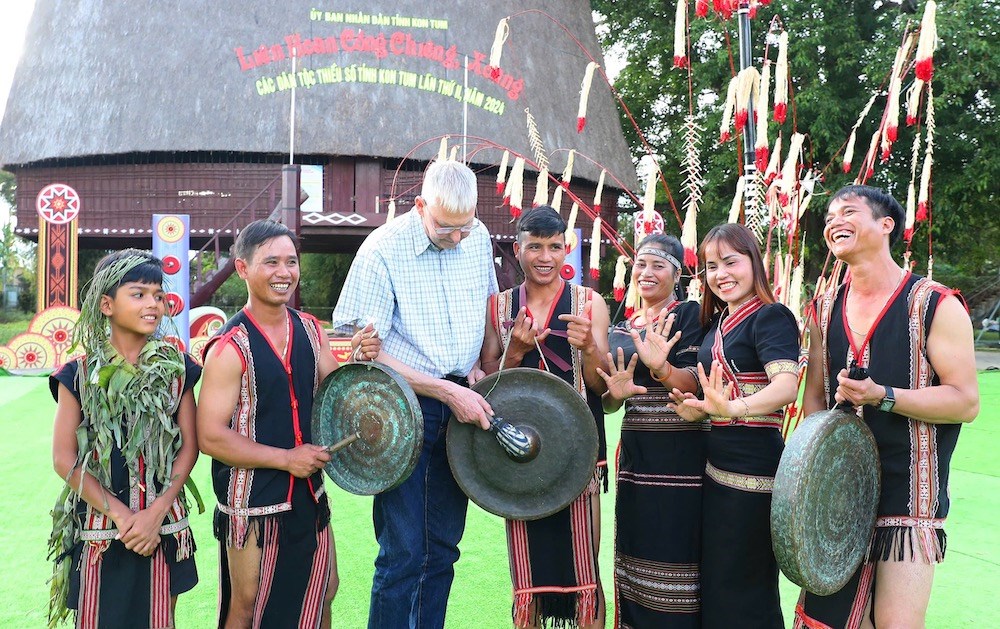
Today, many villages have embraced gongs as part of their community tourism programs. Kon K’Tu cultural village, just six kilometers from Kon Tum city, is one of the most renowned. Here, under the soaring roof of the rong house, visitors gather around a glowing fire. Gongs resound into the night as villagers perform the xoang dance, rice wine flows from earthen jars, and the line between guest and host dissolves into shared rhythm.
Similarly, Bahnar and Jrai communities in Kong Chro, Mang Yang, and Chu Pah have opened their doors to travelers eager to experience gong culture. In these villages, the festival atmosphere is not staged, but lived – a continuation of traditions that have endured for centuries.
For those who come to Gia Lai, the gong experience is inseparable from the rong house, the great heart of every village. Towering high above the stilted homes, its sweeping roof and wooden carvings embody strength and unity. Once the exclusive setting for rituals and council meetings, the rong house now also welcomes travelers, offering a chance to sit beneath its beams and learn about indigenous architecture, storytelling, and folk art.
The cultural journey continues through the taste of the mountains. Simple yet unforgettable, dishes such as bamboo rice, grilled chicken, leaf soup (canh lá bép), forest bamboo shoots, and grilled stream fish are prepared using local methods that preserve their natural flavors. Shared in the flickering firelight, paired with rice wine and accompanied by gongs and dance, a meal becomes a full immersion into the life of the Central Highlands.
Keeping the Gongs Alive in Modern Life
As interest in cultural tourism grows, Gia Lai has been careful to nurture its heritage while creating new opportunities. Homestay models in villages like Kep (Pleiku city), Kong Chro, and Mang Yang now allow visitors to live alongside Bahnar and Jrai families – joining in daily tasks, learning crafts, and of course, listening to gongs at dusk.
The province has also invested in training programs, equipping villagers with skills in hospitality, cultural interpretation, and food preparation. Gong artisans, instrument makers, and brocade weavers are being encouraged to participate directly in tourism, ensuring traditional knowledge is passed on while creating sustainable livelihoods.
New tours combine cultural experiences with natural wonders – from the tranquil beauty of Biển Hồ to the thunder of Phú Cường Waterfall, or the volcanic landscapes of Chu Đăng Ya. In every itinerary, the gongs resound as both entertainment and heritage, adding depth to the natural scenery.
When the gongs of Gia Lai ring out across the mountains, they carry more than sound. They carry pride, resilience, and an invitation to the world. They remind us that heritage is not something to be preserved behind glass, but something to be lived, shared, and celebrated. For travelers, the gongs are not just music – they are an entry point into a culture where every beat tells a story, every rhythm connects the past with the present, and every festival becomes a bridge between the Central Highlands and the wider world.
Tourism Information Technology Center