
(TITC) – Amid the majestic northern mountains, the Hmong King’s Palace in Tuyen Quang (formerly part of Ha Giang) stands as a unique architectural masterpiece deeply intertwined with the history, culture, and life of the local Hmong people. More than just a symbol of a glorious past, the palace is now a captivating destination for travellers seeking to explore the rich traditions and distinctive architecture of Vietnam’s northern highlands.
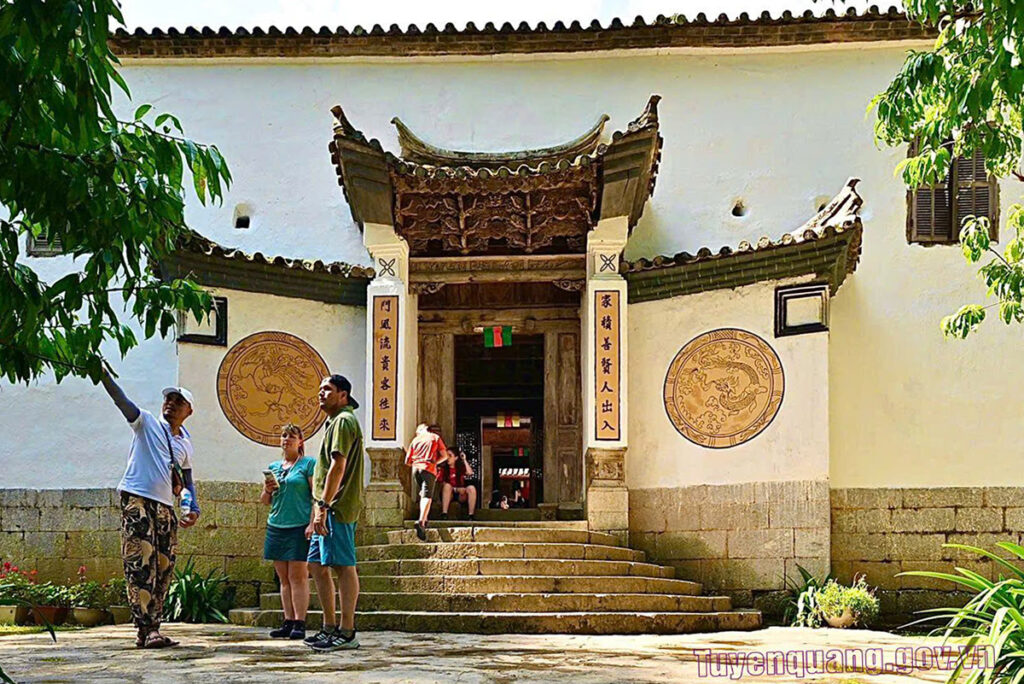
The entrance gate to the Hmong King’s Palace. (Photo: tuyenquang.gov.vn)
The palace was built by the powerful Vuong family, a prominent Hmong clan in the early 20th century. The head of the family at the time, Vuong Chinh Duc, was revered by his people as the “Hmong King” for his influence, leadership, and contributions to the region. Construction of the palace began around 1919 and took nearly ten years to complete, with the participation of hundreds of skilled craftsmen from the Hmong, Chinese, and Kinh (Vietnamese) ethnic groups.
Perched on a mountain slope and covering an area of more than 1,000 square meters, the palace backs onto towering limestone ranges and faces a broad valley below. The structure features a fascinating blend of traditional Hmong, ancient Chinese, and French colonial architecture. Major components include the stone gate, fortified walls, inner courtyard, residential quarters for the Vuong family, guest houses, and storage rooms for grain and weapons. Built with thick mountain stone walls and yin-yang tiled roofs, the palace exudes both a sense of timeless elegance and the power and wealth of the Vuong dynasty.
What makes the Hmong King’s Palace truly remarkable is the intricate craftsmanship in every detail. Decorative motifs such as clouds, brocade patterns, tigers, dragons, and phoenixes are carefully carved into wooden pillars, doors, and railings, symbolizing prosperity, protection, and strength according to Hmong spiritual beliefs. Inside, the rooms are designed with both practicality and defense in mind, a crucial consideration during times of conflict and instability along the border region.
Beyond its architectural grandeur, the Hmong King’s Palace also holds immense historical significance. It once served as a political, economic, and military center for the highlands, bearing witness to stories of defense, alliance, and transformation throughout the 20th century. The palace later became an important meeting point between local Hmong leaders and the revolutionary government.
Today, the Hmong King’s Palace is not only a heritage site but also a living museum that preserves the cultural soul of the Hmong people in the northern mountains. Surrounded by misty peaks and ancient forests, the palace evokes a sense of mystery and pride, reminding visitors of a once-prosperous era in the highlands. Walking through its stone corridors and wooden chambers, one can almost hear echoes of the past, the bustling life of the Vuong family, the rhythm of traditional Hmong rituals, and the stories of resilience passed down through generations.
As tourism continues to grow, the palace has become a highlight on the cultural map of Tuyen Quang and northern Vietnam. It attracts not only historians and architecture enthusiasts but also travellers who wish to immerse themselves in the authentic atmosphere of the Hmong homeland. The preservation and promotion of this historical site not only honor the legacy of the Hmong King but also contribute to protecting and celebrating the rich ethnic heritage of the Vietnamese highlands.
A visit to the Hmong King’s Palace is more than a sightseeing journey, it is an encounter with history, artistry, and the indomitable spirit of the mountain people who have shaped this land for centuries.
Tourism Information Technology Center