
(TITC) – The Chhay-dăm drum dance, a unique cultural symbol of the Khmer community in Tay Ninh, has long been an indispensable feature of major festivals such as Chol Chnam Thmay, Dolta, and Ok Om Bok. With its vigorous, flexible movements, the dance is not only performed on stages and temple grounds but also in the courtyards of local homes, embodying the unity, vitality, and joy of the Khmer people.
The drum itself is the soul of the dance. Crafted from jackfruit wood, the drumhead is made from buffalo hide to produce deep, resonant tones. Each drum has a minimum diameter of 30 centimetres and a body length ranging from 50 to 70 centimetres. Its base is fitted with a metal cone that amplifies the sound over a wide area. Before every performance, the drum is carefully cleaned, the straps checked, and the hide dried in the sun to ensure even tension. Performers don brightly coloured costumes – short beaded shirts sparkling with sequins, paired with shimmering silver or gold sampot (xà-banh) – drawing the eyes of the audience.
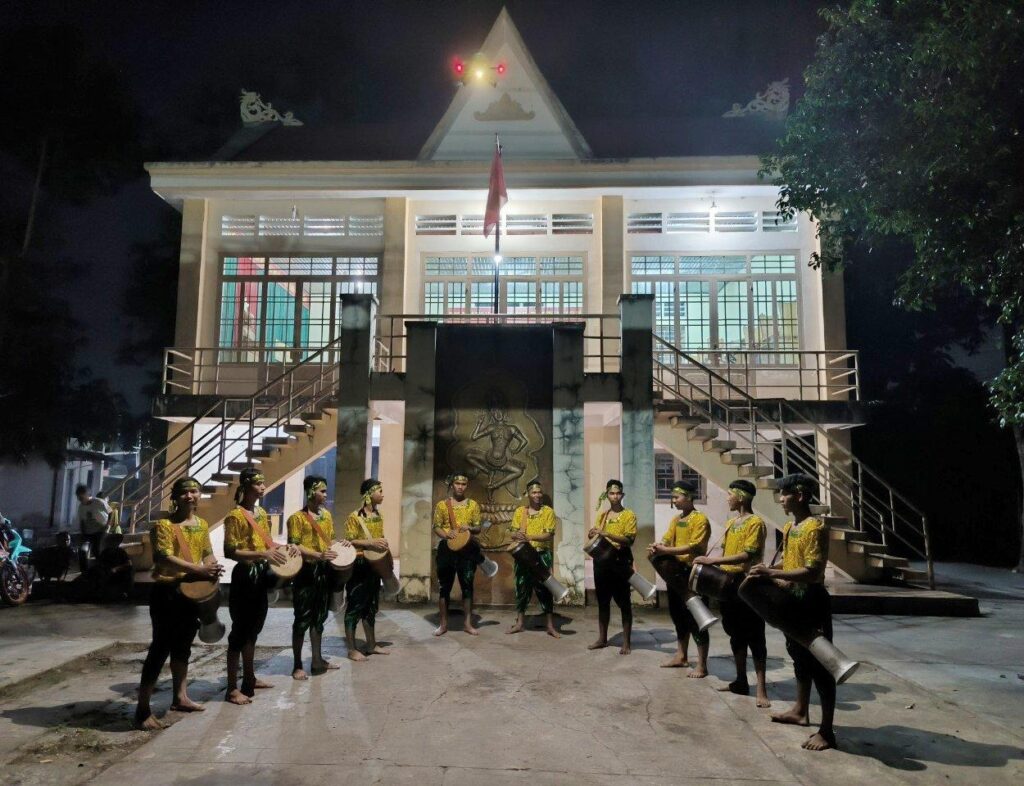
Khmer youths in Truong Tay commune, Hoa Thanh town (Tay Ninh) during a Chhay-dăm drum dance practice. Photo: Internet
The sampot, a traditional Khmer garment, is a three-meter-long, one-metre-wide cloth skillfully wrapped around the waist, pulled through between the legs, and secured with a metal belt, resembling trousers rather than a skirt. For women, the sampot is often paired with a chang pong, a cloth wrapped around the chest that leaves the midriff bare, creating a graceful look. Wrapping the sampot is an art in itself, with evenly pleated folds and a firm knot to withstand the vigorous movements of the dance.
The performance can feature from a single dancer to dozens, requiring intricate choreography to produce a harmonious and striking display. Its movements carry a martial arts influence, blending solo, paired, and group sequences. Performers use not only their hands and feet but also elbows, knees, and even heels to strike the drum, creating the distinctive lop-cop sound as the drum base taps the ground. The rhythm: cak tum tum, tum tum tup, alternates between rapid and gentle beats, stirring excitement and energy in the spectators. A complete performance typically lasts at least seven minutes, progressing from an opening greeting to displays of skill and strength, and concluding with a memorable farewell.
Compared to Chhay-dăm drum dances in the Mekong Delta, the Tay Ninh version is more forceful in style. It requires no elaborate makeup or musical accompaniment, relying instead on martial-inspired movements such as low stances, somersaults, drum strikes, and mock duels. Traditionally, it is performed by men, as the Khmer believe the drum to be sacred, demanding both strength and endurance.
As a form of anonymous folk art, the Chhay-dăm drum dance emerged from the labor and creativity of generations, passed down within the community. Though it lacks a formal musical notation, the Khmer people continue to preserve and innovate the dance, teaching it to younger generations. Today, it is performed at cultural centers, Khmer festivals, ceremonies at the Cao Dai Holy See in Tay Ninh, and in competitions and cultural exchanges, leaving a lasting impression on audiences.
The Chhay-dăm drum dance is more than art; it is a bond that unites the community. When the drums resound, worries seem to fade, replaced by joy and hope. Within each troupe, members openly share experiences and support one another, working together to deliver vibrant, dazzling performances that express the solidarity of the Khmer people.
Preserving this heritage requires active efforts within the community, from regular practice to skill transmission. Action programmes, financial support for artisans, and promotional activities through media play a vital role in keeping the tradition alive. These initiatives not only safeguard cultural values but also contribute to local economic development.
Thanks to its uniqueness, since 2014, the Chhay-dăm drum dance of Truong Tay commune, Hoa Thanh town, has been recognized as a National Intangible Cultural Heritage of Vietnam, affirming its place in the nation’s rich cultural treasury.
Tourism Information Technology Center