
(TITC) – Cao Bang, a mountainous province in northern Vietnam, is not only known for its majestic landscapes but also for its rich cultural heritage, shaped by diverse ethnic communities. Among its many traditional treasures, the Khau Sli cake of the Tay and Nung people stands out – a humble yet meaningful delicacy that carries the warmth of family gatherings, festive spirit, and the essence of the highlands.

A Cake with a Story
For generations, Khau Sli has been a familiar presence during Tet and community festivals. In the Tay and Nung languages, “Khau Sli” can be understood as “popped sticky rice cake,” though locals often call it the “mouth cake” – a name that reflects both its simple appearance and its place in everyday life.
What makes Khau Sli special is not only its taste but also the care and skill required in its preparation. It is said that a good cake must be soft yet crisp, golden yet not burnt, and fragrant enough to linger on the tongue. Once made only on special occasions, Khau Sli is now produced more widely, packaged in attractive boxes, and even given new flavors to suit modern tastes. Yet at its heart, it remains a symbol of hospitality and tradition.
From Sticky Rice to Golden Squares
The making of Khau Sli is a meticulous process, handed down through generations. The main ingredients – sticky rice, peanuts, and sugar – are simple, yet every stage demands patience and precision.
It begins with selecting the finest sticky rice. Whole, unbroken grains are essential, as they steam and puff beautifully when roasted, unlike broken grains which fail to expand evenly. The rice is soaked for about eight hours, then steamed until fragrant. After cooling, it is mixed with a small amount of tapioca starch, rice flour, or corn flour to keep the grains separate. This step, though subtle, is crucial – if done poorly, the grains clump and the final cake loses its light texture.
The prepared rice is then dried under the sun, pounded flat, and roasted over a hot pan until the grains puff up, turning crisp and slightly golden. Meanwhile, sugar – traditionally rock sugar – is caramelized until it reaches a warm honey-yellow color. The roasted rice is quickly tossed into the thick syrup, each grain coated evenly in sweetness. Timing is everything; a delay can cause the mixture to harden before it is shaped.
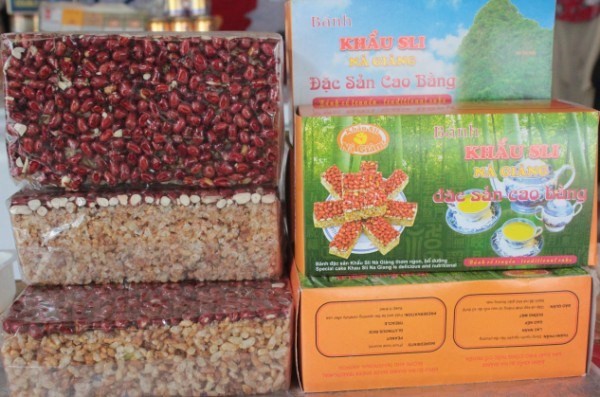
The hot mixture is pressed into wooden molds, rolled firmly with a glass bottle, and topped with roasted peanuts – ivory-colored seeds that add both aroma and a rich, nutty flavor. The cake is cut into neat brick-like blocks, which can later be broken into smaller pieces when served. Once cooled, Khau Sli is wrapped and sealed, ready to last for several months.
More Than a Sweet Treat
Behind its rustic appearance, Khau Sli carries deep cultural meaning. In Tay and Nung households, the cake is not only a festive food but also a symbol of community, hospitality, and love. Families gather around to make it together during the New Year, sharing laughter as the sweet aroma fills the air. Offering Khau Sli to guests is a way of expressing warmth and welcome.
Today, Khau Sli has also become a local specialty that travelers eagerly seek out when visiting Cao Bang. Boxes of the golden cakes are carried home as gifts, representing both the flavor of the mountains and the generosity of its people. For local producers, the cake has grown from a household tradition into a livelihood, with families now making it year-round to meet demand from visitors.
A Taste of the Highlands
Cao Bang’s Khau Sli cake is more than a snack – it is a bite of history, a fragment of cultural identity preserved in sweetness and simplicity. Each crisp, golden square tells the story of careful hands, communal life, and enduring traditions.
For travelers, enjoying Khau Sli is not just about tasting a cake. It is about experiencing the Tay and Nung way of life, where food is woven into culture, festivals, and memories. If you ever find yourself wandering the winding roads of Cao Bang, be sure to pause for a piece of Khau Sli. In its gentle crunch and lingering sweetness, you will taste the essence of the highlands – and the soul of the people who call it home.
Tourism Information Technology Center