
(TITC) – Dong Nai is not only a land rich in revolutionary traditions but also home to many ethnic minority communities, each with its own unique and distinctive cultural identity. To ensure that these values do not fade with time, many individuals have quietly devoted their lives to becoming “storytellers,” collecting, composing, preserving, and passing down the heritage to future generations. Through their efforts, the cultures of Dong Nai’s ethnic minorities are not only safeguarded but also revitalized and brought closer to modern life.
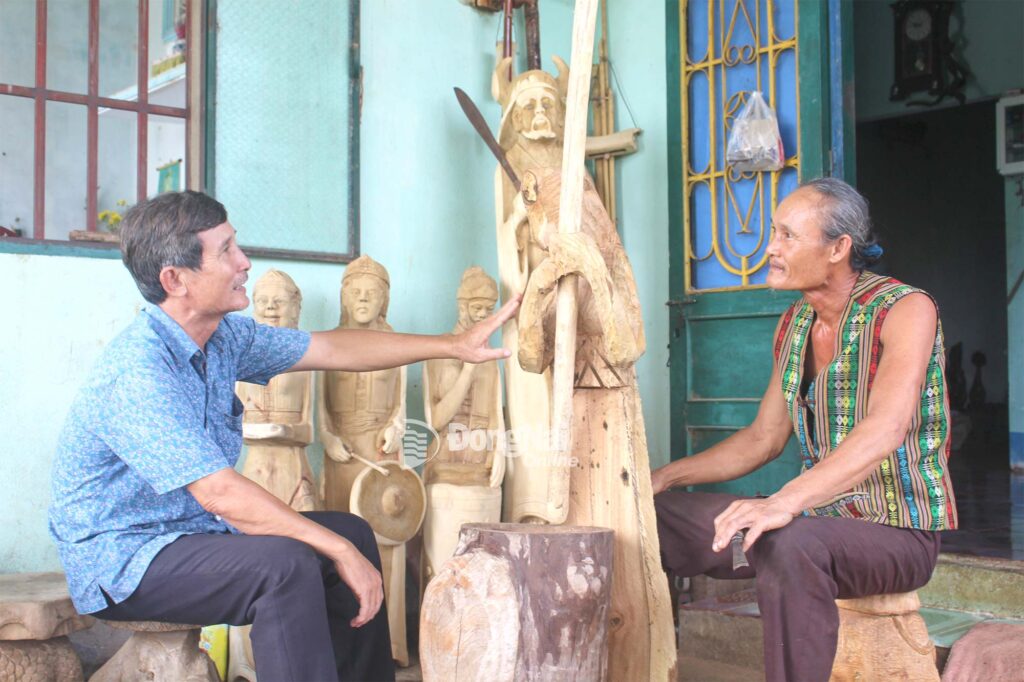
Mr. Nguyen Dinh Du (right), a resident of Thong Nhat Commune, tells the history and culture of the Mường people through wooden sculpture
One outstanding example is writer Khoi Vu – Nguyen Thai Hai (75 years old, residing in Trang Dai Ward). He has chosen literature as the medium to tell the stories of Dong Nai’s history, culture, and people. Over the years, he has published more than 40 works about the province, many of which are written for children to help them approach history in an engaging and memorable way. For him, writing is not only about preservation but also about inspiring national pride in younger generations. Each page he writes captures an encounter, a field trip, or a slice of Dong Nai’s history intertwined with local communities. Through his literature, students can better connect with the people, customs, and traditions of the ethnic minorities who have long lived on this land.
If literature awakens memory, music touches the heart. At over 90 years old, musician Tran Viet Binh has dedicated his life to collecting and preserving the folk songs of ethnic minorities in Dong Nai and the Southeast region. His personal archive contains nearly 200 melodies of the Cho Ro, Ma, S’tieng, Ko Ho, and Cham Islam peoples. To him, each lyric and rhythm embodies the “soul” of a community, a living witness of history. Beyond keeping them in notebooks or recordings, he has revived these melodies through performances and teaching programs for the youth. He believes that only when folk songs are sung and lived in everyday life can cultural identity truly endure.
Sharing the same devotion to preserving cultural essence, Mr. Nguyen Dinh Du from Thong Nhat Commune has chosen to tell the story of the Muong people through wooden sculptures and miniature stilt house models. His works vividly depict the lifestyle, customs, and beliefs of the Muong, from rice pounding and gong dancing to shamanic rituals. Viewers, especially young people, can easily visualize a traditional cultural space through the intricate carvings. For him, each statue and house model are a “wooden chronicle”, simple yet enduring, reminding descendants of their roots.
Beyond creation and collection, these “storytellers” are also bringing ethnic history and culture closer to students. Writer Nguyen Thai Hai regularly organizes exchanges and donates books to children in remote areas. Musician Tran Viet Binh holds folk song classes for young people. Ethnic artisans host hands-on workshops on brocade weaving, gong performances, and traditional dances within their own communities. Such activities turn history and culture into vivid, interactive lessons where students can listen, see, and experience heritage firsthand.
Dong Nai Provincial Museum currently houses tens of thousands of historical artifacts, including extensive collections on ethnic minority cultures. Yet without the dedication of these “storytellers,” such heritage might remain silent exhibits. Thanks to their efforts, ethnic minority culture continues to “live” within today’s society, becoming a source of unity, pride, and cultural vitality among the younger generation.
Amidst rapid urbanization and modern life, the mission of preserving ethnic minority culture has become more meaningful than ever. The “storytellers” of Dong Nai are not merely keepers of memory; they are bridges linking the past with the present, instilling pride and a sense of responsibility for heritage in the hearts of young people. In this way, the cultural identity of Vietnam’s ethnic minorities continues to shine, not only across Dong Nai but also far beyond, enriching the nation’s diverse cultural tapestry.
Tourism Information Technology Center