
(TITC) – In the rich cultural heritage of the K’Ho ethnic people in Lam Dong Province, Chieng Bor – a joyful gong melody imbued with the spirit of affection, attachment, and solidarity – is an indispensable sound in both spiritual life and major village festivals.
If you have the chance to visit K’Ho villages such as Da Blah Village (Lac Duong Commune), you will be deeply impressed by their warm and distinctive welcoming ritual: the Chieng Bor resounds like a greeting, like open arms extended to honored guests. The sound of the gong is not only to be heard but also to be felt – a sincere expression of hospitality and a contagious joy that spreads through every resonant beat.
The Gong Set of Kinship and Origins
According to artisan Ka Să Ha Sang, a proud son of Da Blah Village, a traditional K’Ho gong set includes six gongs, symbolizing a family of six members: father, mother, and four children. Each gong bears its own name, reflecting close family ties and roles: Chieng Me (Mother Gong), Chieng Rơnoai (Father Gong), Chieng Ndơn, Chieng Mboăt, Chieng Blah, and Chieng Cồng (the children).
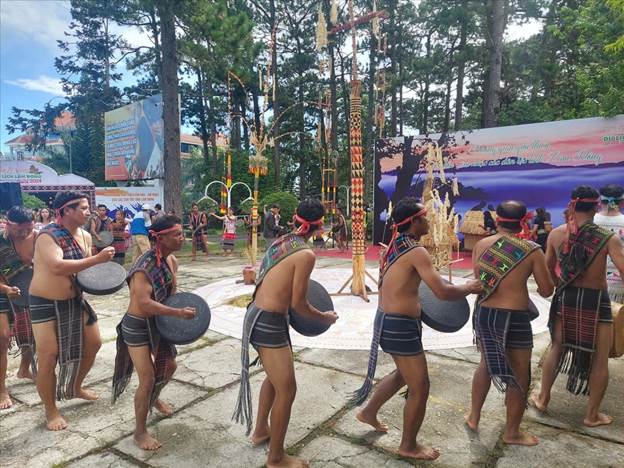
To perform Chieng Bor – a joyful, distinctive gong melody – all six gongs must be present. Missing even one would make the performance incomplete, the harmony broken, much like a family or community lacking unity cannot enjoy complete happiness. This reflects a profound philosophy hidden within the gong’s sound – a lesson about love, compassion, and mutual support among people.
The K’Ho people believe the gong serves as a bridge connecting humans and deities, the present and the ancestors. The gong’s resonance is not merely a sound, but the voice of the soul – a collective consciousness. When Chieng Bor is played, the Mother and Father gongs begin first, as if guiding and protecting. Then the Child gongs respond one after another, saying “Father, Mother,” forming an echoing sequence of rhythms that conveys the joy and harmony of a united, happy family.
Experiencing Central Highlands Culture Through the Sound of Chieng Bor
The space where Chieng Bor resounds is not only a place linking generations within the village but also an ideal destination for travelers seeking authentic local culture. In K’Ho villages, visitors can admire the majestic mountain landscapes, enjoy traditional dishes such as com lam (bamboo-tube rice), grilled chicken, and ruou can (jar wine), and immerse themselves in the vibrant world of gongs and drums – experiencing a living culture preserved faithfully through generations.
Chieng Bor is often performed on special occasions such as housewarming ceremonies, community festivals, weddings, or when welcoming distinguished guests. Its resounding beats seem to dispel fatigue, bringing warmth and sacred emotion to the vast highland atmosphere. It is in these moments that visitors can step away from the bustle of urban life, slow down, and listen to the heartfelt voice of both the mountains and their people.
The profound meaning of Chieng Bor lies not only in its artistic and ceremonial value but also in its message of unity and togetherness – from the family unit to the village community and beyond, to the entire nation. Only when people love, care for, and move forward together can they build lasting strength and sustainable development.
“In a family, there are elders and young ones; in a community, each person has different roles. But when all share one heart, one purpose – only then can we have a peaceful and prosperous country like Vietnam today,” shared artisan Ka Să Ha Sang.
Chieng Bor is more than a joyful melody – it is a symphony of the mountains and forests, of human affection and the land itself. It is a reminder of our roots, an invisible bond connecting people everywhere to their common homeland – Mother Vietnam. And perhaps, only by listening with one’s heart can visitors truly feel the tender, loving resonance of Chieng Bor echoing across the great Central Highlands.
Tourism Information Technology Center