
(TITC) – In the spiritual life of the Co (Cor) ethnic group, the ceremonial tree-post—known locally as Glấk—is not only a testament to the artisans’ refined carving skills but also a sacred symbol deeply rooted in their beliefs. It serves as a mystical bridge between heaven and earth, a channel through which the people communicate their wishes and prayers to the deities. For the Co community, the Glấk is an essential element of every traditional festival, embodying rich cultural and humanistic values. Almost all of their rituals and folk performances take place around this sacred post.
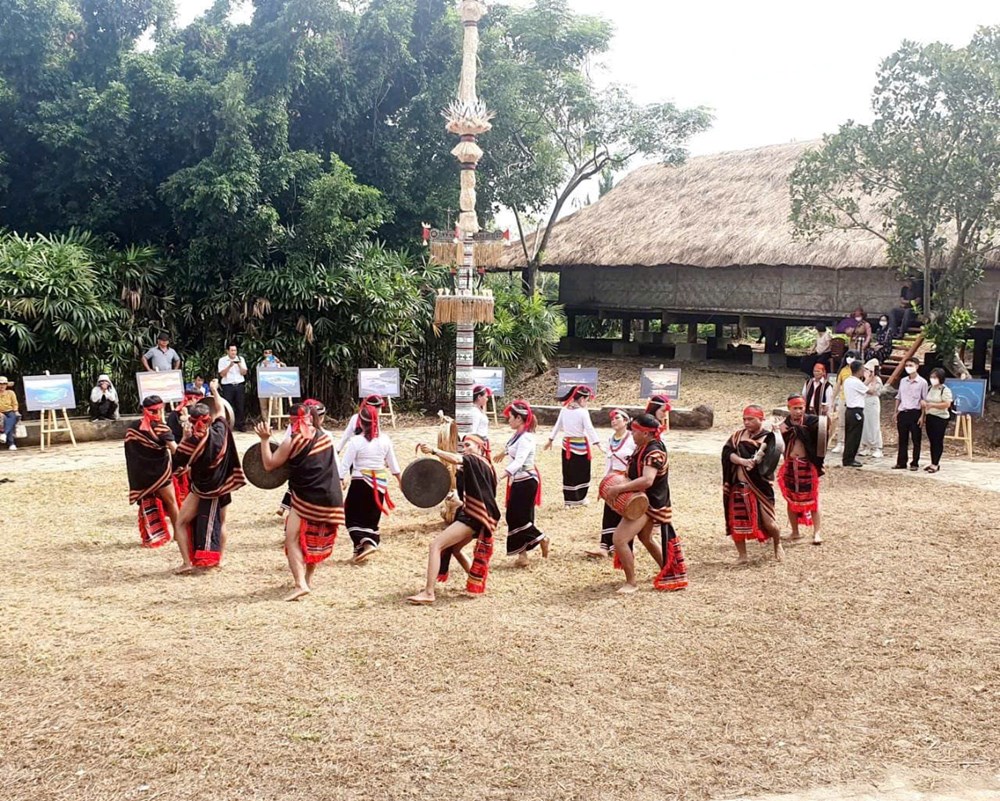
The Co people primarily inhabit the western region of Quang Ngai Province, especially in Tra Bong Commune. Like many other ethnic groups along the Truong Son Mountain Range, the Co attach great importance to two ritual objects in their traditional festivals: the Gu (an indoor decorative altar) and the Glấk (the outdoor ceremonial tree-post). These sacred symbols represent the community’s faith and aspirations, with each carved pattern vividly expressing their early worldview and innocent yet profound philosophy of life.
The Tree-Post and Its Role in Spiritual Life
The Glấk holds a central place in the Co people’s spiritual and cultural life. It symbolizes fertility, growth, and the divine connection between humans and gods. The post is an integral part of various important ceremonies such as the New Rice Festival, rain-praying rituals, village establishment ceremonies, and weddings.
There are many types of Glấk, each corresponding to different social and cultural events, including: Nêu phướn (xa glấk): Erected during the New Rice Festival, standing 10–15 meters tall, this is the most elaborately decorated type, featuring intricate motifs and a hanging pennant of woven leaves, topped with a carved image of the drongo bird.
Nêu thượng (xa cô): Similar to nêu phướn but without the pennant. Nêu lá (xa xje): Made from the chò tree and left with its natural leaves intact, without carvings or a bird figure on top. Nêu bắp chuối (cót kjá): Used in ancestor worship rituals, about 6 meters tall, featuring a banana-flower-shaped top pointing skyward. Nêu dù (gâk đlu): Erected during buffalo sacrifice ceremonies to ward off misfortunes, about 5 meters tall, with a canopy resembling a parasol and a sun-ray motif at the top. This type is unique to the Co community of Duong Rung. Nêu đu đủ (pa lay đu): Built during buffalo sacrifice ceremonies to pray for peace and prosperity, standing over 4 meters tall, with carved wooden papaya fruits and a radiant sun motif near the top.
Artistic Craftsmanship and the Symbolism of Odd Numbers
Constructing a Glấk is a collective artistic endeavor that requires skill, creativity, and teamwork over the course of about one month. Traditionally, young men venture into the forest to select suitable trees, women craft tassels and bead ornaments, while artisans and village elders take charge of carving and painting.
A completed Glấk typically stands between 5 and 15 meters tall, divided into three parts: the base, the trunk, and the top. Its surface is adorned with geometric and symbolic patterns painted in three traditional colors—red, black, and white—and embellished with sacred trays, divine figures, fish motifs, and leaf pennants. All materials and colors are sourced from nature, using plants, stones, and shells.
A distinctive feature of Co artistry is their use of odd numbers (3, 5, 7, 9) in decoration, as these are believed to bring good fortune. The top of every Glấk is crowned with the image of the drongo bird, which the Co believe to be a messenger of the gods, sent from the sky to protect their rice fields—a symbol of peace and abundant harvests.
Throughout generations, the Glấk has remained deeply embedded in the cultural identity and spiritual life of the Co people. It not only showcases the remarkable creativity and craftsmanship of Co artisans but also reflects their enduring desire for harmony, prosperity, and favorable weather amidst the majestic Truong Son Mountains.
In recognition of its exceptional cultural significance, on August 9, 2024, the Ministry of Culture, Sports and Tourism issued Decision No. 2323/QĐ-BVHTTDL, officially recognizing “The Art of Tree-Post Decoration of the Co People” in former Tra Bong District, Quang Ngai Province, as a National Intangible Cultural Heritage. This honor rightfully acknowledges the Glấk as a sacred emblem and a profound cultural symbol of the Co ethnic community.
Tourism Information Technology Center