
(TITC) – Located within the scenic complex of Ao Ba Om and the Khmer Ethnic Culture Museum, Ang Pagoda (Pali name: Wat Angkor Raig Borei) stands as one of the oldest and most representative Khmer temples in Southern Vietnam. Formerly part of Tra Vinh Province, since 1 July 2025, Ang Pagoda officially belongs to Vinh Long Province following the administrative merger of the two localities. Although its geographical designation has changed, the temple’s cultural, historical, and spiritual values remain intact, continuing to be a source of pride for the Khmer community and an irresistible destination for travellers everywhere.

A panoramic view of Ang Pagoda from above
A Temple Rich in History and Khmer Identity
Historical records indicate that Ang Pagoda was originally constructed in 990 and later expanded on a larger scale during the third year of King Thieu Tri’s reign (1842). Over centuries of existence, the temple has undergone several restorations and additions such as monks’ residences and dining halls, yet the main sanctuary (Preah Vihea) has retained much of its original design. In recognition of its exceptional cultural and architectural significance, Ang Pagoda was designated a national historical and cultural relic in 1994.
The temple perfectly embodies the distinctive architectural features of Khmer pagodas in Southern Vietnam. Covering an area of about four hectares, it is surrounded by ancient hopea wood and dipterocarp trees that lend a solemn and tranquil atmosphere. The main gate is adorned with intricate carvings of demons, celestial maidens, and the Garuda bird, all typical of Khmer art. The path leading to the pagoda runs between rows of tall trees and across a wide moat, evoking serenity and reverence.
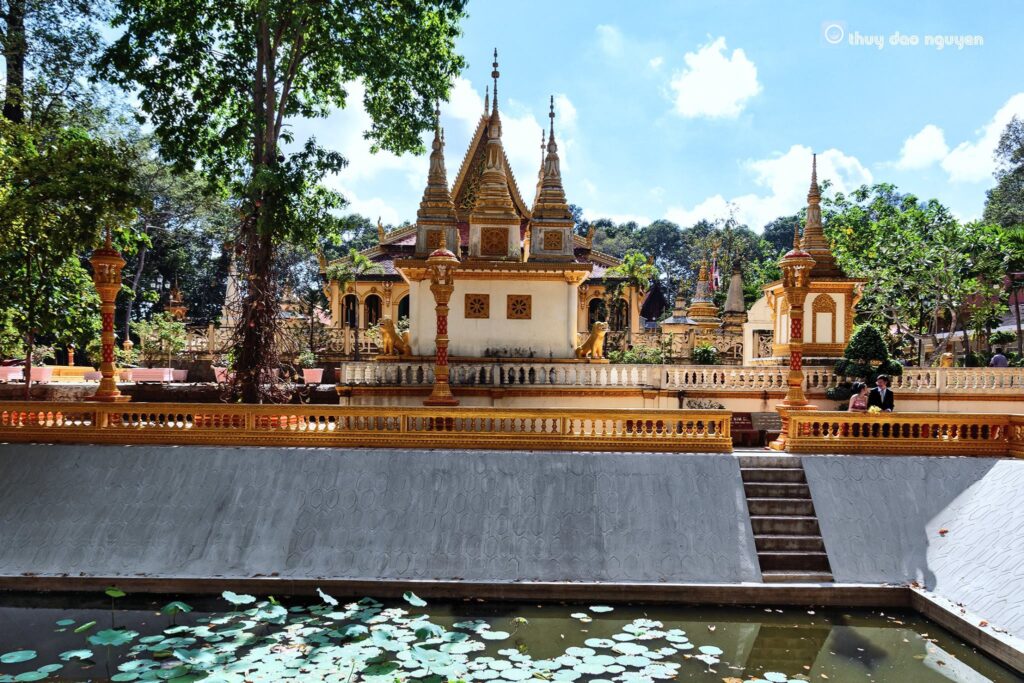
The wide moat surrounding the pagoda keeps the atmosphere cool and refreshing
The main sanctuary, Preah Vihea, supported by 18 wooden pillars, is the most striking structure. Inside, 12 columns are gilded and decorated with dragon motifs, while the walls are entirely covered with murals depicting the life of Buddha. The ceiling features four grand paintings illustrating the key stages of his journey, birth, renunciation, enlightenment, and nirvana. The three-tiered roof, gracefully rising skyward, is intricately carved with Naga serpents, symbolizing the link between the earthly realm and nirvana. In front of the main hall stands a five-spired stupa, a rare structure that houses the ashes of senior monks and reflects the influence of Hindu philosophy within Khmer spiritual life.
The Temple’s Role in the Community and Its Appeal to Visitors
Beyond its function as a religious site, Ang Pagoda serves as a cultural and educational center for the Khmer people. In the past, it was a monastic school where students learned Pali and Khmer scripts, preserving both the language and the intellectual traditions of the community. Thus, the pagoda is not only a place of worship but also a living repository of Khmer cultural memory.
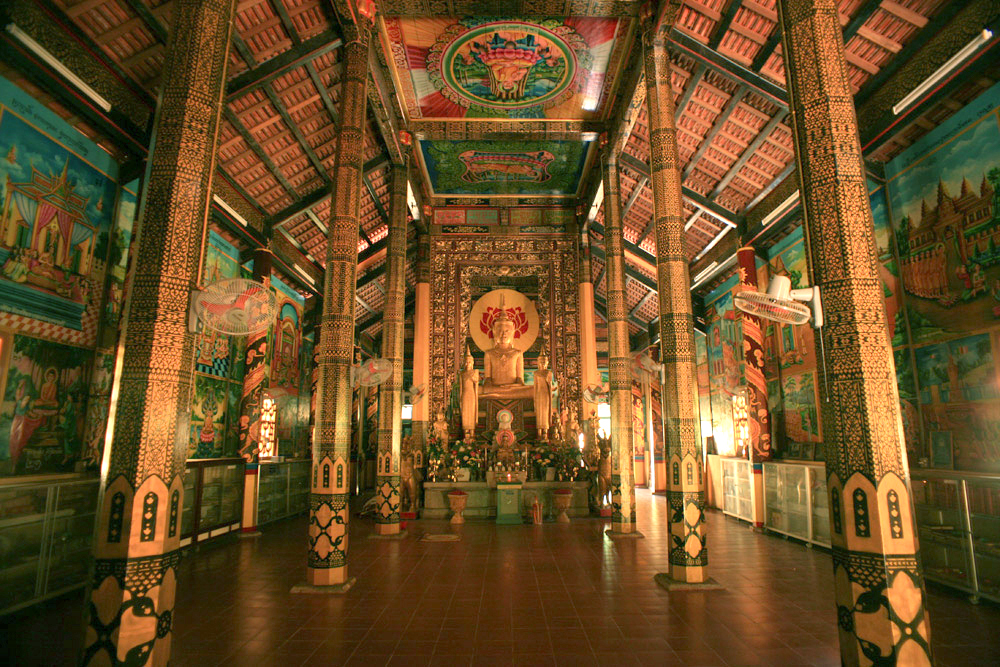
Inside the main hall
Today, Ang Pagoda has become one of Vinh Long’s most captivating spiritual and cultural tourism sites. Visitors come not only to admire its exquisite architecture and sacred atmosphere but also to immerse themselves in Khmer cultural life through vibrant festivals. During Chol Chnam Thmay (Khmer New Year), Dolta (Ancestor Worship Festival), and Ok Om Bok (Moon Offering Festival), thousands of Khmer, Kinh, and Hoa people as well as tourists from across the country gather here, transforming the pagoda into a lively hub of intercultural exchange.
The harmony between architecture, religion, and community life has given Ang Pagoda a lasting vitality and cultural resonance. For travelers, a visit to this ancient temple is not only a journey of spiritual tranquility but also an opportunity to discover the splendor of Khmer heritage, a testament to the enduring spirit, creativity, and unity of the people in Vietnam’s southern lands.
Tourism Information Technology Center